This guide walks you through the complete process to monetize WiFi hotspot using a captive portal
You’re already paying for WiFi.
Every month. Without fail.
And every day, people connect to it for free like it fell from the sky.
That’s not generosity — that’s leakage.
If you run a café, salon, apartment, shop, office, or even a shared home, your WiFi is already a product. You’re just not charging for it yet. This post shows you how to turn that silent expense into a small, disciplined income stream using a paid WiFi captive portal.
No networking degree required. No fantasy tools. Just what actually works.
Table of Contents
What “Monetizing WiFi” Really Means (No Buzzwords)
Monetizing WiFi doesn’t mean selling internet bundles like an ISP.
It means controlling access.
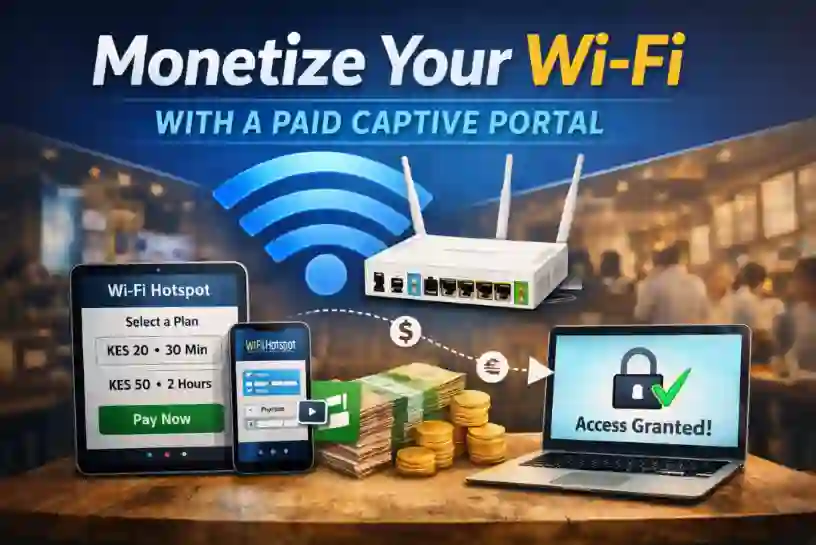
A captive portal is the page users see when they connect to WiFi and try to browse — the internet is blocked until they take an action, usually paying or logging in.
You’ve seen it before:
- At hotels
- At airports
- At coworking spaces
Same idea. Smaller scale. Same money logic.
Connect → Redirect → Pay → Access
That’s the whole business model.
Why Free WiFi Is Quietly Costing You Money
Free WiFi feels friendly. In practice, it causes three predictable problems:
- Abuse
Everyone connects. No one disconnects. Speeds die slowly. - Zero control
One person streams HD movies. Everyone else suffers. - No return
You pay the ISP. Users pay nothing. That math never improves.
Here’s the uncomfortable truth:
People already pay for internet every day — mobile data, bundles, subscriptions.
Paying isn’t the problem.
Lack of structure is.
A paid portal doesn’t scare serious users away. It filters unserious ones out.
What You Need to Get Started (Simple, Realistic)
You don’t need a server room. You need four things.
1. An Internet Connection
Any stable connection works:
- Fiber
- Wireless ISP
- Starlink
For small setups, 10–20 Mbps is enough to start.
2. A MikroTik Router (This Is the Brain)
MikroTik routers are popular because they’re powerful, affordable, and built for this exact job.
Beginner-friendly models:
- hAP lite
- hAP ac²
- RB750Gr3 (Hex)
Typical prices (Kenya estimates):
- New: KES 5,500 – 12,000
- Refurbished: KES 3,000 – 7,000
Refurbished is perfectly fine. MikroTik hardware is durable and forgiving.
3. An ISPledger Account (The Billing Engine)
ISPledger handles:
- Packages
- Payments
- Time limits
- Expiry
- Reports
You connect it to your MikroTik router and let automation do the heavy lifting.
Think of it as the cashier that never sleeps. You can register for an ISPledger account here for ksh 500 only.
4. A Payment Method
At least one of the following:
- Bank account
- M-Pesa Paybill
- M-Pesa Till Number
This is where your money lands. Simple.
How the System Works (Big Picture)
Here’s the full flow, stripped of jargon:
- A user connects to your Wi-Fi
- Any website redirects to your captive portal
- They see available packages
- They pay via M-Pesa or bank
- Internet access unlocks automatically
No vouchers.
No staff intervention.
No daily management.
Once set up, it runs quietly in the background.
What Do You Actually Sell? (Packages)
You don’t sell “Wi-Fi”.
You sell time and speed.
Example beginner packages:
- KES 20 – 30 minutes
- KES 50 – 2 hours
- KES 100 – 24 hours
- KES 300 – Weekly access
You control:
- How long users stay online
- How fast they browse
- How many devices they connect
Few packages work better than many. Confusion kills payments
What About the Login Page? (The Captive Portal)
This is where most beginners panic. They shouldn’t.
The captive portal is just a web page — built using HTML, CSS, and a little JavaScript. MikroTik already supports this.
It needs to:
- Load fast
- Work on phones
- Show prices clearly
- Explain how to pay
That’s it.
Using AI to Build or Customize the Portal (Shortcut, Not Cheating)
Here’s the unfair advantage:
You don’t need to design anything from scratch.
You can use ChatGPT or any AI model to generate your captive portal.
Example prompt:
“Create a modern, mobile-friendly Wi-Fi captive portal HTML page with package cards, M-Pesa payment instructions, and a clean layout.”
From there, you:
- Change prices
- Add your logo
- Adjust colors
- Upload the files to your router
AI doesn’t replace understanding — it removes friction.
Who Should Monetize Wifi Connection
This setup shines where people:
- Sit
- Wait
- Stay
- Sleep
Examples:
- Cafés & restaurants
- Barbershops & salons
- Hostels & apartments
- Offices & coworking spaces
- Events
If people linger, they’ll pay.
Final Thoughts
You already paid for the internet.
Right now, it’s being consumed freely, noisily, and without gratitude.
A paid captive portal doesn’t make you greedy.
It makes you structured.
In the next post, I’ll walk through the exact setup process — router configuration, packages, payments, and portal files — step by step, without skipping the boring but necessary parts.
Until then, remember:
Your WiFi isn’t free.
You’ve just been giving it away.
Check out our recent posts here.
Mwash Cyber is an online serving cyber café based in Nairobi
- Mwash Cyber

- Mwash Cyber

- Mwash Cyber

- Mwash Cyber