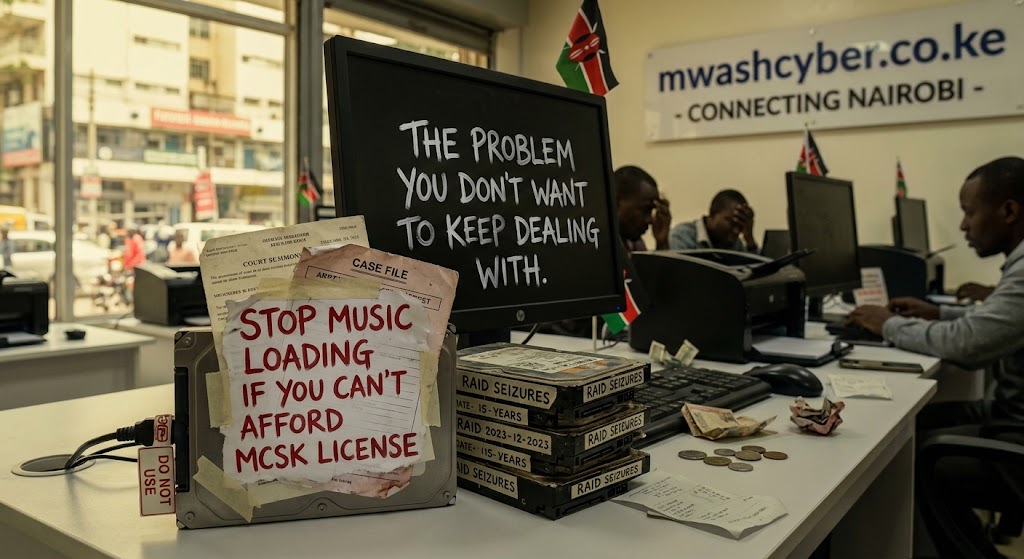
Running a cyber cafe in Kenya comes with enough overhead—high internet costs, electricity bills, software maintenance, and rent. However, one age-old problem continues to put cyber cafe operators across Kenya at risk of sudden business closure: music copyright compliance and enforcement raids.
For years, loading music onto flash drives, memory cards, and hard drives has been a quick revenue add-on for cyber operators. But with continuous raids, confiscated computers, and hefty fines, it is time to ask: Is selling music still worth the risk for your cyber cafe business?
Table of Contents
The Reality of Music Distribution in Kenyan Cyber Cafes
Many cyber cafe owners view music loading as a small side service for customers. However, under Kenyan copyright law, storing and distributing music files on business machines without proper licensing is classified as unauthorized mechanical reproduction and distribution.
This situation exposes cyber operators to severe risks:
- Frequent Machine Confiscations: A single raid by inspectors or law enforcement can result in seized CPUs, hard drives, and lost work days.
- The Extortion Loop: Paying out-of-pocket bribes or emergency bail to recover confiscated equipment drains your daily profits.
- Zero Support from the Music Industry: Cyber cafes bear 100% of the legal and financial risk to distribute tracks, while getting no compensation or protection from music rights organizations or artists.
MCSK, KAMP, PRISK, and KECOBO: Understanding the License Burden
To legally play or distribute music commercially in Kenya, businesses are required to hold valid licenses from Collective Management Organizations (CMOs) monitored by the Kenya Copyright Board (KECOBO).
These organizations historically include:
- MCSK (Music Copyright Society of Kenya) – Authors, composers, and publishers.
- KAMP (Kenya Association of Music Producers) – Sound recording producers.
- PRISK (Performers Rights Society of Kenya) – Musicians and performers.
If your cyber cafe cannot comfortably afford or justify these licensing fees alongside standard operational costs, storing music folders on your local servers is a financial liability.
3 Steps to Protect Your Cyber Cafe Business Today
To protect your equipment, avoid harassment, and run a fully compliant digital service business in Kenya, consider making these operational shifts:
1. Wipe Offline Music Folders from Your Drives
Remove all pre-stored music archives (Bongo, Gengetone, Gospel, Afrobeats, etc.) from your server units and desktop drives. If your hard drives contain no copyrighted audio files, there is no physical evidence for inspectors to question or confiscate.
2. Pivot to “Bandwidth Only” Services
Instead of selling predefined music packs, let clients access open web browsers or streaming platforms directly using their paid internet time or personal data. Your business acts purely as an internet service provider (ISP) for browsing, rather than a file distributor.
3. Focus on High-Margin, Safe Digital Services
Shift your business focus toward services that bring higher profit margins without copyright risks:
- eCitizen, KRA, and NTSA portal assistance
- Document design, typing, and high-volume printing/scanning
- Computer repairs, software installations, and IT support
- Device charging and accessories sales
Conclusion
A cyber cafe is designed to empower communities through digital access, document preparation, and online services. Selling music for KES 20 to KES 100 per device is not worth risking a KES 50,000 computer or dealing with constant operational disruptions.
About The Author

Leave a Reply
You must be logged in to post a comment.