Copied!

Category Online And Social Media Scam Watch

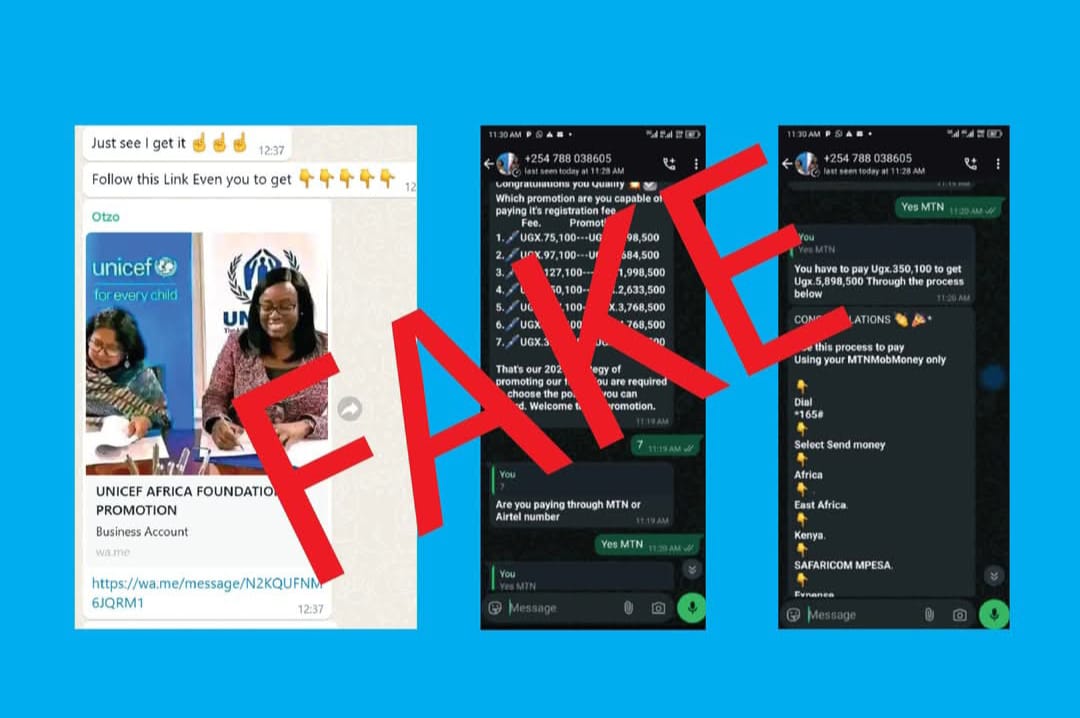
A screenshot showing unicef promotion is fake

UNICEF Promotion in Kenya: A Cautionary Tale of Scams


In recent times, social media platforms in Kenya have been buzzing with posts about a supposed UNICEF promotion offering cash grants or loans to individuals.

However, it’s crucial to clarify that UNICEF promotion is not real and is, in fact, a scam designed to exploit unsuspecting individuals.

The Nature of the Scam

The fraudulent promotion uses the reputable name of UNICEF (United Nations Children’s Fund) to lend credibility to its claims. Here’s how it typically operates:

  • Fake Social Media Accounts: Scammers create or hijack accounts on platforms like Facebook, naming them something akin to “UNICEF Foundation Promotion” or “UNICEF African Foundation.” These accounts post about a cash giveaway or loan program.
  • Misleading Messages: Messages or posts claim you can receive substantial amounts like Kshs 65,000 for merely engaging with the promotion or providing personal details. They often include screenshots of supposed M-Pesa notifications to seem authentic.
  • WhatsApp Contact: Participants are directed to contact via WhatsApp or are asked to send private messages to learn more or to claim their “winnings.” Here, they’re either asked for upfront fees to process the payment or for personal information, which can lead to identity theft.
  • No Official Endorsement: UNICEF has explicitly stated through its official channels, including warnings on their verified X (formerly Twitter) account and official websites, that no such promotion exists. They’ve advised the public not to engage with these fraudulent offers.

Why UNICEF Promotion Is Not Real

Several factors confirm this promotion as a scam:

  • UNICEF’s Official Stance: UNICEF Kenya has issued fraud warnings, emphasizing they do not run promotions or offer loans through social media or WhatsApp. They only communicate official news through verified channels.
  • Lack of Official Documentation: There are no announcements, press releases, or mentions on UNICEF’s global or Kenya-specific websites about this promotion.
  • Poorly Crafted Messages: These scams often contain grammatical errors, use unprofessional language, and the communication style does not align with UNICEF’s formal communication protocols.
  • Request for Money: Legitimate organizations do not ask for payment or personal details to receive aid or grants.

Protecting Yourself

To avoid falling victim to this and similar scams:

  • Verify Through Official Channels: Always check with UNICEF directly through their official website or social media accounts before believing any promotional news.
  • Be Wary of Unsolicited Offers: If you didn’t sign up for something, be skeptical of any offer that comes out of the blue.
  • Never Pay to Win: No legitimate grant or promotion requires payment to claim a prize or benefit.
  • Guard Your Information: Never share personal or financial details without verifying the legitimacy of the requester.
  • Report and Alert Others: If you encounter these scams, report the accounts or posts to the platform and inform others, especially those in your community, to prevent further victims.

Conclusion

The UNICEF promotion scam is just one example of how fraudsters exploit the trust people place in respected organizations. By staying informed, vigilant, and skeptical of too-good-to-be-true offers, you can protect yourself and help others avoid these deceptive practices. Remember, UNICEF supports children and families through official channels and does not run cash promotions or offer loans through social media scams.

It's a scam! The anita utv promotion

Is the Anita UTV Promotion Real? A Detailed Investigation


The Anita UTV promotion has been making waves across digital platforms, particularly in Kenya, where it has captured the attention of many. However, the legitimacy of this promotion has come under scrutiny, prompting a closer look into what seems to be a too-good-to-be-true scenario.

What is the Anita UTV Promotion?

The promotion supposedly tied to UTV a Kenyan free-to-air channel, claims to offer substantial cash prizes to viewers or fans of a show purportedly named “Anita”. According to messages circulating on platforms like WhatsApp and Facebook, participants are promised winnings like Kshs 65,000 for simply being fans or viewers of the show.

The Evidence Against Its Legitimacy

Several independent reports and analyses have cast doubt on the authenticity of this promotion:

  • Mwash Cyber has published multiple articles warning about the scam. we have highlighted that there is no official record or announcement from UTV regarding such a promotion. Instead, these messages originate from individuals posing as representatives of UTV or Anita, often using personal WhatsApp numbers or compromised accounts to spread their messages.
  • YouTube videos and social media alerts have echoed these sentiments, with content creators warning their audience not to fall for this scam. They emphasize that legitimate promotions from UTV or any reputable broadcaster would not require upfront payments or personal information through informal channels like WhatsApp.

Why It’s a Scam

  • Request for Money: Legitimate promotions do not ask for money, especially not for registration or to claim a prize. The scammers often demand payment for various fees, which is a red flag for deception.
  • Lack of Official Communication: There’s no trace of this promotion on UTV’s official website or social media platforms.
  • Use of Personal Channels: Scammers use personal numbers for communication rather than official business lines or platforms.
  • Personal Information Requests: Asking for details like ID numbers and bank details under the guise of a promotion is a common tactic used by fraudsters to harvest information for identity theft or further scams.

User Experiences

Several accounts from individuals who thought they had won through this promotion share similar stories of being asked to pay registration or verification fees. After payment, communication is either blocked or demands increase for additional payments, with no prize ever being delivered.

Conclusion

Based on the available evidence and the consensus from media analyses, the Anita UTV promotion is overwhelmingly considered a scam. Here are key takeaways:

  • Be Wary of Unsolicited Messages: Especially those asking for personal details or money.
  • Check Official Sources: Always confirm promotions through official channels like the broadcaster’s website or verified social media accounts.
  • Never Pay to Win: Genuine promotions do not require payment to claim a prize.
  • Protect Personal Information: Never share personal or financial details with unverified contacts.

For those in Kenya or anywhere else tempted by such promotions, remember the old adage: if it sounds too good to be true, it probably is. The Anita UTV promotion serves as a cautionary tale in the digital age, where scams can easily proliferate through popular communication channels. Stay vigilant and protect yourself from falling prey to such deceptive practices.

Scam

Beware of Rucepo Promotion Scam: Scammers are Here Yet With a New Scam


The Rucepo Promotion is not Real, it’s a scam circulating on Facebook and WhatsApp in East Africa.

Scammers today are increasingly inventive, using social media to deceive unsuspecting individuals. The “RUCEPO Promotion” is one such scam making rounds in Kenya. It falsely claims affiliation with the Rural Urban Culture and Environmental Promotion Organization (RUCEPO)—a seemingly legitimate name that is being misused. This article will explain how this scam works and why it’s important to avoid it.

Rucepo promotion

How the RUCEPO Promotion Scam Works

The scammers, posing as representatives of RUCEPO, create Facebook pages that look legitimate, sharing posts about “promotions” or “loans” supposedly offered by the organization. They often lure people in by announcing that RUCEPO is running a special promotion or loan scheme, where large sums of money are supposedly available—provided you pay an upfront fee.

The Catch
They present a carefully structured list, where the higher the loan amount, the more you need to pay upfront. The scam is cleverly disguised, with the promise that once you pay the fee, you will receive the funds immediately. However, this is a trap. Once you make the payment, they vanish, leaving you with nothing but regret.

What You Need to Know

It is crucial to understand that loans and promotions in Kenya are highly regulated by the government. In particular, loans must adhere to guidelines set by the Central Bank of Kenya (CBK), and every legitimate loan provider is registered and licensed. Similarly, any promotion or lottery must be regulated and authorized by the Betting Control and Licensing Board (BCLB), and they are issued serial numbers and licenses to validate their operations.

Red Flags to Watch Out For

  • Upfront Charges: Any offer that requires you to pay a fee before receiving funds is a major red flag. Legitimate loan providers do not ask for payments in advance.
  • No Official Registration or License: Always verify whether the loan provider or promotion is registered with CBK or BCLB. Scammers rely on people not checking these details.
  • Social Media Only Presence: Legitimate organizations will have official websites, contact details, and physical offices. Scammers rely solely on social media for anonymity.

Don’t Fall for the Trap

No matter how convincing the RUCEPO Promotion scam may seem, it’s vital to stay informed and vigilant. Always verify the legitimacy of any promotion or loan offer before engaging with it. Remember, the more you know about the laws regulating loans and promotions, the safer you will be from scammers like these.


Stay safe, and don’t fall for the trap!


It's a scam! The anita utv promotion

Anita UTV Promotion is A Scam, A Scammer Encounter

Is Anita UTV Promotion Legitimate?
No, Anita UTV Promotion is not legitimate; it is a scam orchestrated by online fraudsters who continuously devise new tactics to deceive unsuspecting individuals.

In this article, I’ll share my experience with a scammer I encountered in November 2023. My goal in writing this is to assist others in recognizing and avoiding similar scams disguised as legitimate offers.

An cartoon image of a man looking at this phone

Anita UTV promotion is a scam

Encounter With Anita UTV Promotion Scammer

A sunny day in Nairobi provided a pleasant change from the month’s usual chill. Sunlight streamed through the window, casting a warm glow over my cluttered desk. Engaged in my tasks, a chirp broke my concentration. A WhatsApp message appeared, drawing me from my work. With a sigh, I paused and checked my phone to see what awaited.

The sender’s name, Titus Okwemba, caught my eye. Intrigued, I couldn’t resist opening the unexpected message. “Hello,” he wrote, a simple yet intriguing greeting that sparked my curiosity.

Curious, or perhaps due to the urge to open every WhatsApp message, I promptly replied: “Hello, how can I assist you?”

I had no idea that this conversation would plunge me into a world of deception and scams. Titus then asked a strange question: “Do you watch UTV?” Puzzled but curious, I replied, “Occasionally. Why do you ask?” It was a Lie.

Titus then introduces a program on UTV named “Anita,” offering viewers an alluring 65,000/= in a promotional deal. However, suspicions arose, making me wonder if it was just a clever scam aimed at unsuspecting people.

Initially hesitant, I gradually engaged in the conversation. I relished uncovering impostors and scammers, analyzing their deceitful tactics. With a playful spark, I encouraged Titus to continue his tricks.

Titus swiftly provided a new WhatsApp number, 0717***988, claiming it belonged to Anita from UTV. This initiated the actual deception. He assumed I was a fan, often using terms like “dear” in our chats.

Curiosity led me to join the charade. When asked about my profession, I added some embellishment. I mused, “Everyone knows Martin Mbucho is the top Kenyan author and blogger.” But to keep up the facade, I replied, “I work as a mechanic.” This small lie allowed me to delve deeper into his theatrical scam.

Titus became excited, curious about how I found the WhatsApp channel and Anita Show promotion on UTV. I made up a story about a friend recommending the promotion. I even said “Vituko vya Anita” aired Tuesdays at 8 p.m. on UTV to make his scam sound more credible.

During our conversation, Titus suddenly asked for a list of personal details: my legal name, age, phone number, county, and ID number. I couldn’t help but laugh at the boldness of his request. With a playful smile, I chose to give him false information, fully aware that the game was on.

Titus informed me that I had won Kshs 65,000 for being a dedicated fan, expressing gratitude for my support of the show. However, his message included a request for a Kshs 999 registration fee. Instantly, alarm bells went off in my mind. This was often where scams exposed their true nature.

To catch Titus off guard, I nonchalantly inquired, “Is there a website where I can register and pay?” His reply was simple: they didn’t have a website, and the number he had given earlier, 070***789, was the one to use for payment.

Eager to reveal his true identity, I chose to go along with his demands. Instead of paying the entire registration fee, I pretended to have only 400 shillings. I asked Titus if he could loan me the remaining 500 shillings, assuring him I would repay him after settling the fee. His hesitation was noticeable, yet he reluctantly agreed, directing me to send the 400 shillings to the contact he had given.

As the conversation unfolded, a barrage of questions and messages exchanged between us. Titus eventually called me from a different number, 0735***341. He mentioned that a friend of mine had already contributed Ksh 299 for the same promotion, leaving just 700 shillings to hit the promised 65,000/= jackpot. My curiosity was sparked. I inquired about the friend’s identity, hoping to catch him unprepared. However, instead of stumbling, he said he would verify and get back to me.

Undeterred, I approached the initial contact again, requesting the 299 shillings. I feigned that by paying directly, the winnings would be credited to his account instead of mine. I assumed he wouldn’t entertain such an idea. Yet, to my surprise, he hesitated, revealing uncertainty. It was then that I realized both WhatsApp contacts were, in fact, the same individual masquerading as two different personas.

Intent on unmasking this charade, I chose to comply with his requests. I inquired if I could forward the cash to him for the registration fee he was supposedly covering for me. Meanwhile, in another conversation, I asked if the number I was meant to send the money to was the same as the one posing as the “good Samaritan” who allegedly connected me to UTV offers. He confirmed that I should send it to phone number 0735***341, pretending it was a relatively new contact. To further the ruse, I questioned him about Airtel’s transaction fees, and he provided another number, 0712***776, assuring me it would bypass the “hefty charges.”

Despite my efforts, I couldn’t get him to confess to his scam. Frustrated yet resolute, I chose to write this blog post and send it his way. With nothing to lose, I hoped that by revealing his deceitful tactics, I might prevent others from becoming his victims.

What is the Anita UTV Promotion Scam?

The Anita UTV Promotion scam is a deceptive scheme where victims receive messages on WhatsApp or Facebook, falsely suggesting they have won significant amounts of money. These messages are part of a scam designed by fraudsters aiming to exploit unsuspecting individuals for financial gain.

Why is the Anita UTV Promotion a Fraud?

The Anita UTV Promotion is a fraudulent scheme with no legitimate existence. Scammers send deceptive messages, convincing people they’ve won prizes. They typically request personal information or payments, exploiting these for their own gain.

What Platforms are Commonly Exploited for Scams?

Scammers mainly target victims through WhatsApp and Facebook, often using either their own accounts or compromised accounts of acquaintances to make the scam appear more credible.

When Do Scams Happen?

The scam can occur at any time. Scammers often target vulnerable groups, such as women and the elderly, who they perceive to be more trusting and less familiar with digital scams.

Tips for Staying Safe

To safeguard against scams, always confirm the source of any information. If a message appears questionable, it likely is. Authentic TV promotions are communicated via official websites and respective TV stations, with payments, if necessary, directed to registered Paybill or Till numbers. Be wary of messages promising large sums of money, particularly if they request personal information or payments. Report any suspicious messages to the relevant platform and local authorities.

Remember, if it sounds too good to be true, it probably is. Stay vigilant and stay safe.

Read More Posts
Check out our online Shop